


World STEM Day is an opportunity to turn ordinary classrooms, libraries and homes into spaces for discovery. Students can design bridges, investigate renewable energy, build simple machines, collect environmental data or solve challenges using everyday materials.
Whether you are an elementary school teacher looking for easy STEM activities, a middle school student planning a science project or a high school educator organizing an engineering challenge, this guide offers practical ideas for celebrating STEM Day in 2026 and continuing STEM learning throughout the year.
Looking for the Turkish edition? Read our 2026 Dünya STEM Günü guide in Turkish.
When Is World STEM Day 2026?
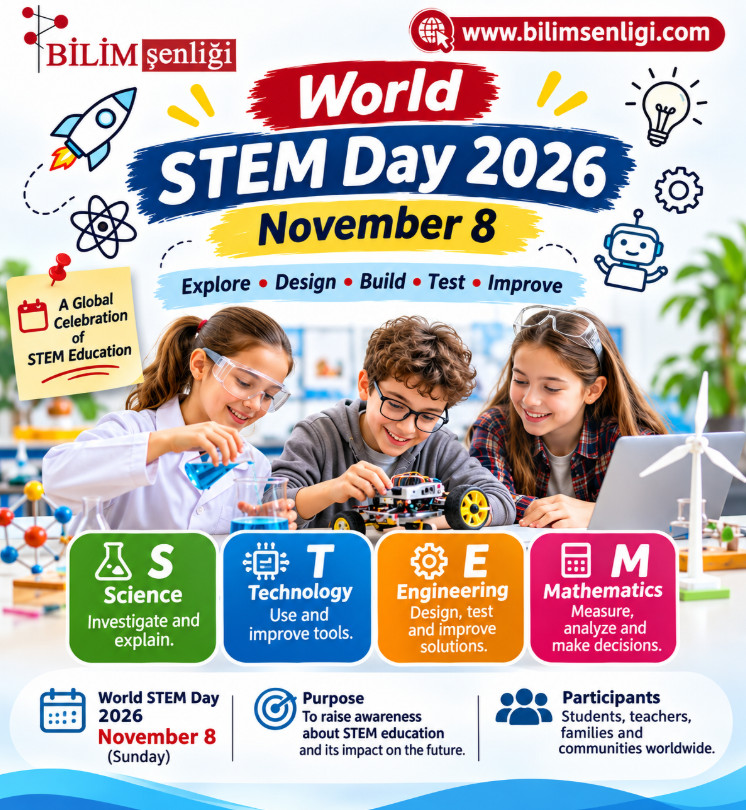
STEM Day is observed annually on November 8. In 2026, November 8 falls on a Sunday. Schools may choose to organize activities on the preceding Friday, the following Monday or another suitable date.
| Question | Answer |
|---|---|
| When is STEM Day? | November 8 every year |
| When is World STEM Day 2026? | Sunday, November 8, 2026 |
| What does STEM stand for? | Science, Technology, Engineering and Mathematics |
| What does STEAM add? | Arts, including creative design and artistic approaches |
| Who can participate? | Students, educators, families, libraries and community groups |
| Is expensive equipment necessary? | No. Many activities use paper, cardboard, tape and recycled materials. |
Why Is STEM Day Celebrated on November 8?
The November 8 observance developed from National STEM/STEAM Day in the United States. MGA Entertainment established the celebration in 2015 to encourage young people’s interest in science, technology, engineering, arts and mathematics.
The date has a memorable wordplay: NOV8, combining the abbreviation for November with the number eight, resembles the word innovate.
Today, educators and organizations in different countries use November 8 to promote hands-on STEM learning. Some describe it as National STEM Day, while others use World STEM Day or International STEM Day.
Important distinction: November 8 STEM Day is not a United Nations General Assembly-designated international observance. It should not be confused with UNESCO’s World Science Day for Peace and Development, observed on November 10.
What Is STEM Education?
STEM education connects four related disciplines to help learners investigate real-world questions and develop practical solutions.
Science: Investigate and Explain
Science involves observing natural phenomena, asking testable questions, collecting evidence and evaluating explanations. Students might investigate plant growth, heat transfer, water quality or the properties of different materials.
Technology: Use and Improve Tools
Technology includes digital systems, but it is not limited to computers or robotics. Measuring instruments, simple mechanisms, communication tools and useful design methods can all contribute to a STEM project.
Engineering: Design, Test and Redesign
Engineering asks students to create solutions within constraints. Learners identify a problem, sketch possible designs, build a prototype, test its performance and improve the design using evidence.
Mathematics: Measure and Make Decisions
Mathematics allows students to compare results, calculate quantities, identify patterns and communicate findings through tables, graphs and models.
For example, designing a paper bridge can involve investigating forces, selecting construction techniques, measuring the load a structure supports and comparing several prototypes. The strongest learning happens when students explain why one design performed differently from another.
Why Is STEM Education Important for Students?
Well-designed STEM activities create opportunities for students to practice skills that are useful across many subjects and careers:
- Critical thinking: Evaluating evidence rather than relying on guesses.
- Problem-solving: Breaking a complex challenge into manageable steps.
- Creativity: Generating and testing multiple possible solutions.
- Collaboration: Sharing responsibilities and discussing different ideas.
- Communication: Explaining decisions, results and limitations clearly.
- Data literacy: Measuring outcomes and interpreting graphs.
- Resilience: Learning from unsuccessful prototypes and improving designs.
These benefits depend on how an activity is taught. Simply assembling a model does not automatically produce meaningful STEM learning. Students need opportunities to ask questions, make decisions, collect evidence and reflect on their results.
STEM vs. STEAM: What Is the Difference?
STEM stands for Science, Technology, Engineering and Mathematics. STEAM adds Arts, which may include visual communication, product design, creative expression and other artistic approaches.
Consider a challenge to design an energy-efficient classroom. Students might investigate insulation, calculate energy consumption and test building materials. A STEAM approach could also involve visual design, accessibility, user experience and communicating the solution through illustrations or models.
Both approaches can support interdisciplinary learning. The most appropriate choice depends on the educational goals and the problem being explored.
10 Easy STEM Activities for Elementary School Students
Elementary STEM projects work best when instructions are clear, materials are familiar and students can observe a result directly. The following activities can be adapted to different ages and learning needs.
1. Build the Strongest Paper Bridge
Materials: Paper, two stacks of books, tape, a ruler and identical small weights.
- Place two stacks of books a fixed distance apart.
- Lay a flat sheet of paper across the gap.
- Add identical small weights gradually and record the number supported.
- Fold another sheet into an accordion shape and repeat the test.
- Compare the designs and explain the results.
STEM question: How does the shape of a bridge influence the load it can support?
Evidence to collect: Span length, bridge shape and maximum supported load.
Extension: Challenge students to create a stronger bridge using the same amount of paper.
2. Design a Tower Using Paper and Tape
Materials: Paper, masking tape, a ruler and a timer.
- Give each group an equal number of paper sheets and the same length of tape.
- Ask students to build the tallest freestanding tower possible.
- Measure the height after the tower stands independently for ten seconds.
- Discuss how a wider base, triangular supports or rolled paper columns affect stability.
- Allow a second construction round using the same material limits.
STEM question: Which design choices improve stability without using additional materials?
3. Investigate Paper Airplane Flight
Materials: Identical sheets of paper, measuring tape and a clear indoor space.
- Create two airplane designs using the same paper size.
- Launch both from a marked line under similar conditions.
- Measure the distance traveled in three trials per design.
- Calculate the average distance and compare the results.
- Change one feature, such as wing width, and test again.
STEM question: How does wing design influence flight distance?
Safety: Never launch airplanes toward faces or crowded areas.
4. Create a Mini Water Filter Model
Materials: A clear container, clean gravel, sand, a coffee filter and water mixed with a small amount of soil.
Students build a simple layered filter, pour the soil-water mixture through it and compare the appearance of the water before and after filtration.
STEM question: How do different filter layers affect visible particles in water?
Critical safety note: The filtered water is not safe to drink. This activity demonstrates the removal of some visible particles; it does not establish that harmful microorganisms or dissolved contaminants have been removed.
5. Explore Shadows and Sunlight
Materials: Chalk or paper, a pencil, a fixed object and a clock.
Trace the shadow of a fixed object at different times of day. Measure shadow length and direction, record the time and discuss how the Sun’s apparent position relates to the observations.
STEM question: How does the shadow of a stationary object change over time?
Safety: Do not look directly at the Sun.
6. Build a Balloon-Powered Car
Materials: Cardboard, bottle caps, straws, tape and a balloon.
With adult supervision, students assemble a lightweight vehicle, attach a balloon propulsion system and measure how far the car travels. Compare wheel alignment, vehicle mass and the amount of air released.
STEM question: Which design changes help a balloon-powered vehicle travel farther?
7. Test Different Insulating Materials
Materials: Equal ice cubes, identical containers, fabric, paper and a timer.
Wrap containers with different materials and compare how quickly equal ice cubes melt under similar room conditions. Students record time and the amount of remaining ice.
STEM question: Which material slows melting under the conditions tested?
8. Design a Marble Maze
Materials: Cardboard, paper strips, tape and a large marble.
Students create a maze with barriers and slopes, then investigate how changing the path affects travel time. Use age-appropriate materials and avoid small parts with children who may put them in their mouths.
STEM question: How can a path be redesigned to control the marble’s movement?
9. Make a Simple Balance Scale
Materials: A ruler, string, two identical lightweight cups and a stable support.
Students create a balance and compare the masses of small classroom objects. Discuss fair comparisons, equal arm lengths and the difference between mass and volume.
STEM question: How can a simple device compare the mass of two objects?
10. Design a Recycled-Material Shelter
Materials: Cardboard, paper, tape and clean recycled packaging.
Ask students to build a miniature shelter that can protect a paper figure from a simulated light rain using a small amount of water. Compare roof shapes and record leakage.
STEM question: Which roof designs direct water away most effectively?
7 STEM Project Ideas for Middle School Students
Middle school STEM activities can introduce more detailed measurement, controlled comparisons, research and evidence-based explanations.
1. Earthquake-Resistant Building Challenge
Students build small structures from craft sticks, paper or other classroom materials. Place the models on a teacher-prepared, low-risk shaking platform and compare their stability under similar movement conditions.
Investigation: How do bracing patterns, base width and building height influence model stability?
Data: Model height, material quantity, shake duration and observed movement or damage.
The activity is a simplified classroom model, not a reliable test of real building safety.
2. Water-Saving Irrigation System
Challenge students to design a gravity-fed watering system using reused bottles, tubing and containers. Compare the amount of water delivered over equal time periods.
Investigation: How can water delivery be made more consistent while reducing unnecessary runoff?
3. Solar Oven Design Challenge
Use cardboard, reflective foil, transparent covering and dark paper to investigate solar heating. Compare temperatures in different model designs using suitable thermometers.
Investigation: How do reflector angle and surface color affect measured temperature?
Safety: Avoid direct viewing of reflected sunlight, sharp edges and hot surfaces. Conduct the activity with adult supervision and do not prepare food in unverified classroom devices.
4. Smart Greenhouse Model
Students explore how temperature, light and soil moisture affect plant conditions. A basic version uses manual observations; an advanced version can incorporate sensors and a microcontroller.
Investigation: How could measured environmental conditions guide decisions about ventilation or watering?
5. School Energy Audit
Students identify lighting, heating, cooling and electronic devices used in classrooms. They estimate operating hours, compare equipment specifications and propose realistic energy-saving measures.
Investigation: Which changes might reduce energy consumption without compromising safety or learning conditions?
Students should not open electrical equipment or access wiring.
6. Urban Heat Investigation
Measure surface or ambient temperatures in several safe school locations at similar times. Compare shaded areas, pavement and planted spaces while recording relevant environmental conditions.
Investigation: How do surface materials and shade relate to local temperature differences?
7. Accessible Classroom Design
Ask students to investigate a classroom accessibility challenge, such as organizing supplies for easier reach or designing clearer visual instructions. Encourage learners to consult intended users and consider multiple needs.
Investigation: How can a design be improved using feedback and measurable criteria?
8 STEM Project Ideas for High School Students
High school learners can extend STEM Day into research projects involving more rigorous methods, mathematical modeling, programming and iterative engineering.
- Air-quality monitoring: Compare sensor readings at different locations while documenting sensor limitations and environmental conditions.
- Renewable energy optimization: Investigate how the angle of a small educational solar panel affects measured electrical output under controlled conditions.
- Machine learning and recycling: Explore how a simple image-classification model distinguishes clean examples of recyclable materials, then evaluate errors and bias.
- Low-cost assistive design: Develop a prototype that addresses an accessibility challenge identified through appropriate user consultation.
- Rainwater collection modeling: Estimate potential collection volumes using roof area, rainfall data and realistic system losses.
- Bridge efficiency: Compare model structures using a strength-to-material ratio rather than absolute strength alone.
- School food-waste analysis: Collect appropriately anonymized observations, identify patterns and test a practical reduction strategy.
- Climate data visualization: Analyze historical temperature or rainfall data, discuss variability and distinguish long-term trends from short-term weather.
For each project, students should define a research question, identify variables, document their methods and communicate uncertainties. Projects involving people, personal data or specialized equipment require additional ethical and safety review.
How to Organize a World STEM Day Event at School
A successful school STEM Day does not need to be expensive or complicated. A focused event with clear learning objectives can be more effective than a large exhibition without meaningful student investigation.
Step 1: Choose a Real-World Challenge
Start with a question connected to everyday life, such as reducing water waste, designing safer transport or improving classroom comfort.
Step 2: Define Learning Objectives
Identify what students should understand and demonstrate. Objectives may include measuring accurately, interpreting data, testing a prototype or explaining design decisions.
Step 3: Set Constraints
Give students clear limits on time, materials, size, budget or performance. Fair constraints make it easier to compare solutions.
Step 4: Encourage Multiple Designs
Ask learners to sketch more than one possible solution before construction begins.
Step 5: Build and Test
Students create prototypes and conduct fair, repeatable tests. Teachers help ensure that procedures and materials are safe.
Step 6: Record Evidence
Encourage tables, labeled diagrams, photographs of prototypes where appropriate and short written observations.
Step 7: Improve the Design
Give students time to change one important feature and explain the reason for their redesign.
Students present the question, method, results, limitations and improvements. Celebrate thoughtful reasoning, not only the strongest or fastest model.
Sample 60-Minute STEM Day Lesson Plan
| Time | Activity | Learning Focus |
|---|---|---|
| 0–5 minutes | Introduce the challenge and safety rules | Problem definition |
| 5–15 minutes | Discuss ideas and sketch designs | Planning and prediction |
| 15–30 minutes | Build the first prototype | Engineering design |
| 30–40 minutes | Test and measure performance | Data collection |
| 40–50 minutes | Improve and retest | Evidence-based redesign |
| 50–60 minutes | Present findings and reflect | Communication and evaluation |
This schedule can be adapted for different age groups. Younger students may need additional setup time, while older students may benefit from extended analysis and reflection.
World STEM Week 2026: A Seven-Day Activity Plan
Some STEM education organizations suggest extending the November 8 celebration into a week of learning. For 2026, November 8–14 can be used as an optional planning window. It is not a universally mandated international STEM Week schedule.
| Date | Suggested Theme | Activity |
|---|---|---|
| November 8 | Ask | Identify a real-world problem and develop questions |
| November 9 | Investigate | Compare materials or test a scientific prediction |
| November 10 | Engineer | Build and evaluate a prototype |
| November 11 | Code | Explore algorithms through an unplugged or digital challenge |
| November 12 | Measure | Collect numerical data and create a graph |
| November 13 | Collaborate | Work on a local community problem |
| November 14 | Share | Present evidence, prototypes and improvements |
Schools can select individual activities instead of following the entire week. The objective is sustained curiosity rather than completing a fixed calendar.
How Can Teachers Assess STEM Projects?
STEM assessment should consider the process as well as the final product. A prototype that fails but leads to a well-supported explanation can demonstrate substantial learning.
| Criterion | What to Look For | Suggested Weight |
|---|---|---|
| Problem understanding | Clear question and relevant constraints | 20% |
| Scientific reasoning | Appropriate predictions and evidence | 20% |
| Design and testing | Thoughtful prototype and fair tests | 20% |
| Data interpretation | Accurate measurements and justified conclusions | 20% |
| Communication and reflection | Clear explanation and meaningful improvements | 20% |
These percentages are an example rubric, not an official grading standard. Teachers should adjust them to their curriculum and students’ needs.
Free and Low-Cost STEM Materials
Many STEM challenges can be completed with inexpensive, reusable classroom supplies:
- Paper, cardboard and clean packaging
- Masking tape, string and child-safe scissors
- Rulers, measuring tapes and timers
- Reusable containers and bottle caps
- Craft sticks and drinking straws
- Graph paper, notebooks and pencils
- Basic thermometers and weighing scales where available
Computers, robotics kits, 3D printers and programmable boards can extend STEM learning, but they are not prerequisites. The most important resources are a meaningful question, opportunities to test ideas and time to reflect on evidence.
Making STEM Day Inclusive and Accessible
STEM activities should welcome learners with different abilities, backgrounds, interests and levels of prior experience.
Teachers can provide written and spoken instructions, offer seated versions of challenges, use tactile materials where appropriate and allow different methods of presenting results. Avoid assigning technical tasks based on gender stereotypes. Rotate responsibilities so that all students can participate in design, measurement, construction and presentation.
Inviting diverse STEM professionals to share their experiences can also help students recognize the range of people and careers involved in scientific and technological work.
How Can Parents Celebrate STEM Day at Home?
Families do not need specialized equipment to encourage STEM learning. Everyday questions can become investigations:
- Which paper airplane design travels farther?
- Why does ice melt at different rates in different locations?
- How can a cardboard package be redesigned to protect a fragile object?
- What patterns can be found in daily weather observations?
- How can household water use be measured and reduced?
Parents can support learning by asking open-ended questions such as “What do you predict?”, “How could we test that?” and “What would you change next time?” Allowing children to explain their thinking is often more valuable than providing an immediate answer.
STEM Careers: Where Can STEM Learning Lead?
STEM skills contribute to many career areas, including:
- Environmental science and conservation
- Mechanical, civil and electrical engineering
- Software development and cybersecurity
- Data science and statistics
- Healthcare technology and biomedical engineering
- Renewable energy and sustainable design
- Agricultural technology and food systems
- Architecture, transport and infrastructure planning
- Robotics and automation
- Scientific research and education
STEM education is not only preparation for a specific profession. It also helps learners evaluate evidence, understand technologies and make informed decisions in daily life.
World STEM Day 2026: Frequently Asked Questions
What date is World STEM Day 2026?
World STEM Day 2026 is observed on Sunday, November 8, 2026.
Is STEM Day celebrated every year?
Yes. November 8 is the recurring date associated with National STEM/STEAM Day and the wider STEM Day celebration.
Is World STEM Day an official United Nations day?
No. November 8 STEM Day is not a United Nations General Assembly-designated international observance.
What does STEM stand for?
STEM stands for Science, Technology, Engineering and Mathematics.
What is the difference between STEM and STEAM?
STEAM adds Arts to the four STEM disciplines, incorporating creative and artistic approaches where relevant.
What are good STEM activities for elementary students?
Paper bridges, paper towers, paper airplanes, shadow investigations, simple balance scales and recycled-material design challenges are practical starting points.
What are good STEM projects for middle school?
Earthquake-resistant model buildings, water-saving irrigation systems, school energy audits and small greenhouse investigations can support meaningful middle school learning.
Can students celebrate STEM Day without coding?
Absolutely. Coding is one possible tool, but STEM learning also includes experiments, measurement, engineering design and mathematical reasoning.
Do schools need expensive robotics kits?
No. Many high-quality STEM activities use low-cost materials and simple measurement tools.
Can STEM Day be celebrated on a school day instead of November 8?
Yes. Since November 8, 2026 falls on a Sunday, schools may organize their events on a nearby school day.
When is STEM Week 2026?
November 8–14, 2026 is one suggested seven-day planning window used by STEM.org. It is not a mandatory global schedule.
Is World STEM Day the same as World Science Day?
No. STEM Day is associated with November 8, while UNESCO’s World Science Day for Peace and Development takes place on November 10.
How can teachers make a STEM activity more meaningful?
Use a clear problem, define measurable success criteria, encourage predictions, collect evidence and give students an opportunity to improve their designs.
What should students include in a STEM project presentation?
A strong presentation explains the problem, proposed solution, materials, testing method, results, limitations and next steps.
Conclusion: Celebrate World STEM Day by Asking, Building and Discovering
World STEM Day 2026 on November 8 is an invitation to make learning active, collaborative and evidence-based. Students do not need expensive equipment or advanced technical knowledge to participate. A sheet of paper, a carefully designed question and a fair test can become the beginning of a meaningful scientific investigation.
For teachers, the most valuable STEM Day activities are those that encourage students to think independently, measure outcomes, explain their reasoning and improve their ideas. For families, STEM Day offers a chance to discover science and engineering in everyday life.
Start with one question. Build a possible answer. Test it. Learn from the evidence. Then try again.
Published by Bilim Şenliği – Education, Science and Learning.
